
Recently Restored Model of The China House in Laeken
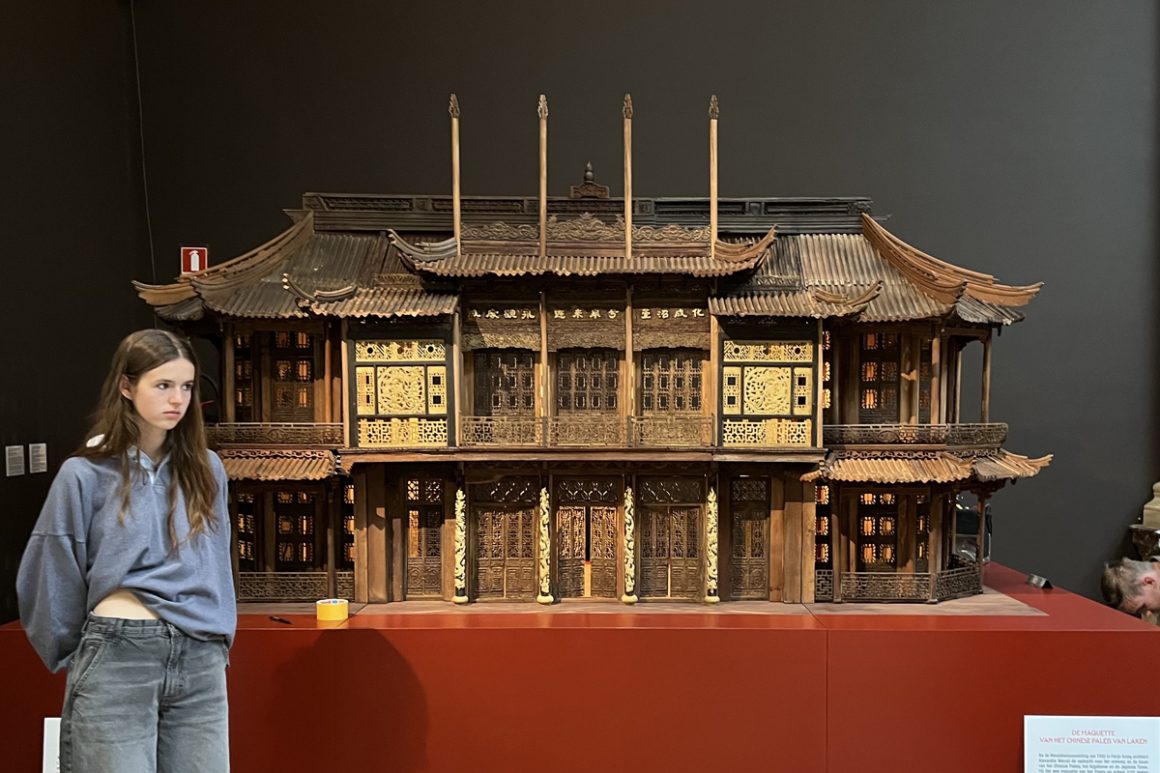
Restored with the support ofthe King Baudouin Foundation, Guest of Honour of BRAFA 2026, the scale model of the Chinese Palace in Laeken will be presented on stand no. 85 of The China House and the Silk Roads Countries.
Shown alongside the wide range of works and initiatives supported by the King Baudouin Foundation on its BRAFA stand, this remarkable maquette offers a further illustration of the Foundation’s outstanding commitment to the preservation and promotion of Belgium’s cultural and artistic heritage.
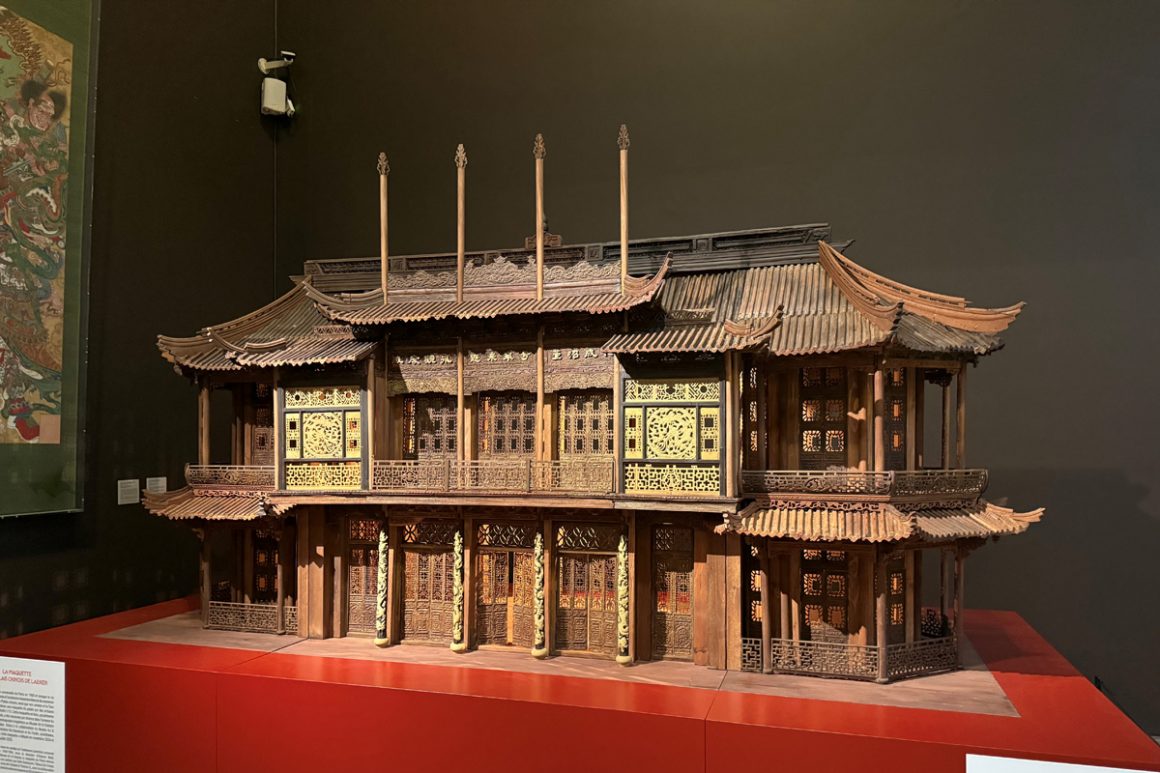
Carved wood, 3D printed elements-wood filaments, resin elements obtained by molding,
3.20m (width), 1.80m (height), 80cm (depth),
Collection China House Palace and the the Silk Roads Countries.
Courtesy: Brafa 2026
After the Universal Exhibition in Paris in 1900 and when the French architect Alexandre Marcel was commissioned to design and build the China House and its annexes (stables and kiosk), as well as the Japanese Tower, he order a model of the house in Shanghai, made by Chinese craftsmen on a scale of 1:10. This wooden model, which has many sculpted and decorative details, was kept for a long time at the Royal Museums of Art and History (now called Art & History Museum) in many little parts. With the help of the museum, the René and Karin Jonckheere Fund managed by the King Baudouin Foundation, Frank and Déborah Donck, the restoration of this model began in November 2024 and was completed in July 2025 at the initiative of the non-profit organisation China House and the Silk Roads Countries.
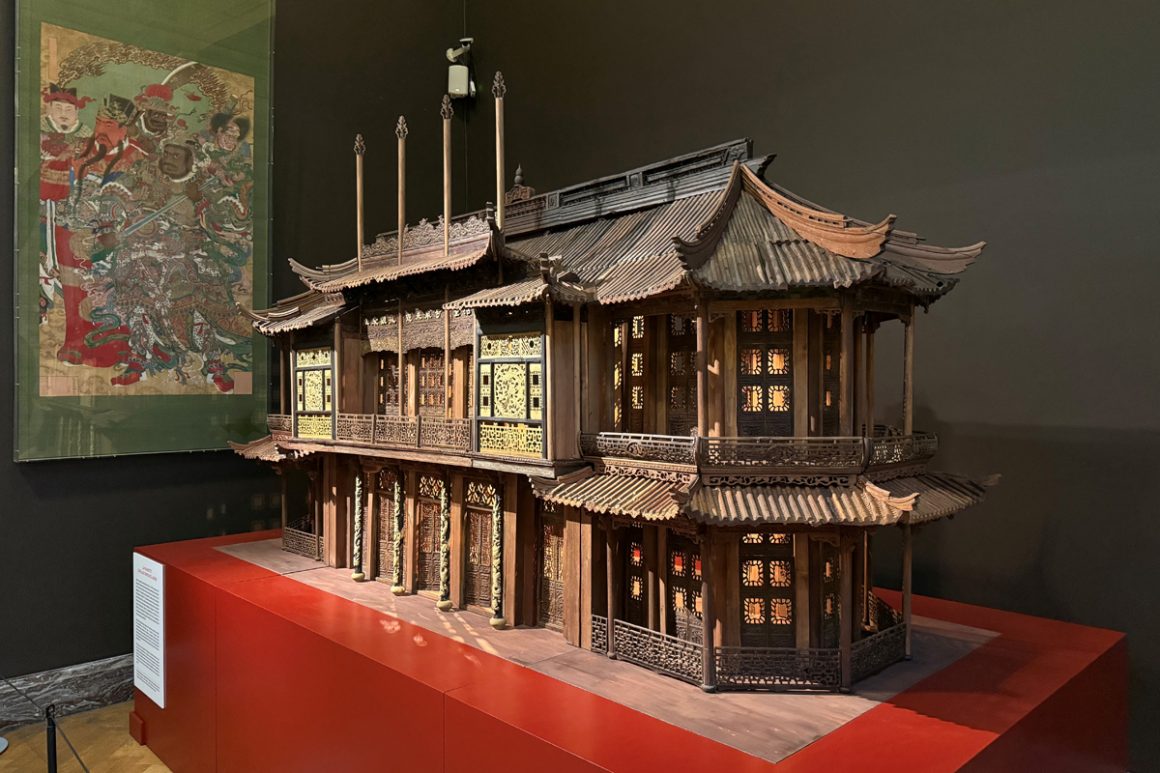
Carved wood, 3D printed elements-wood filaments, resin elements obtained by molding,
3.20m (width), 1.80m (height), 80cm (depth),
Collection China House Palace and the the Silk Roads Countries.
Courtesy: BRAFA 2026
The model was made in Shanghai in the workshops of Tushanwan (formerly Romanized as T’ou-Sè Wè) in 1903-1904, under the direction of Aloysus Beck, saved by the Art & History Museum and restored in 2024-2025 in its workshops by Sofie Gonnissen, Thibaut De Coster, Charly Kleinermann, Anna de Callataÿ and Thomas S., with the collaboration of Gwenaëlle de Spa (digitization and 3D printing) and Nicolas Godelet (architecture).
According to the archives found of the China House in Brussels and Shanghai, the model was built in 1903. It probably arrived in Belgium at the end of 1904 with one of the shipments from Shanghai for the construction of the China House.
It is thanks to the Consul General of Belgium in Shanghai, Mr. Bruno Jans, that the model makers in charge of this restoration obtained old photographs and drawing of the model taken from the Tushanwan album originally intended for King Leopold II and kept in Shanghai. This allowed them to faithfully reconstruct the model and scan the missing elements on this basis, in order to 3D print them.
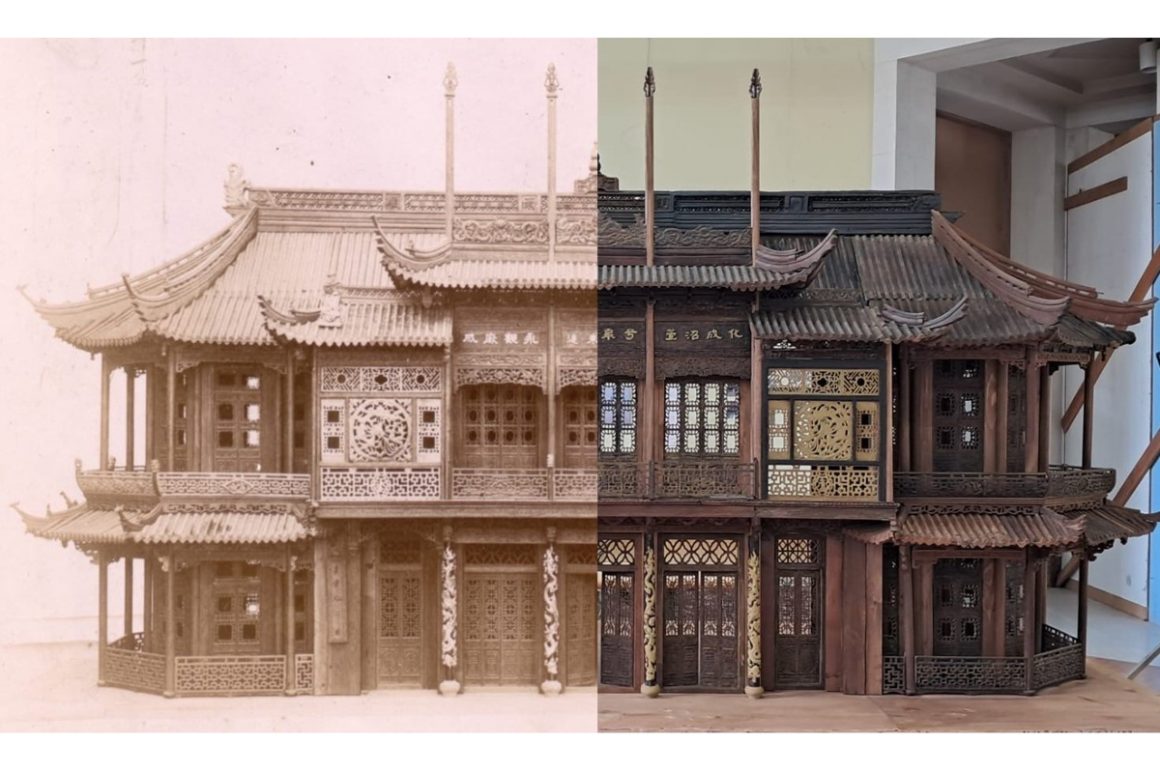
Old photo and finished model
Courtesy: BRAFA 2026
A brief history of the China House
The French architect Alexandre Marcel was responsible for this unexpected building in the landscape surrounding the Royal Palace of Laeken (Brussels). Originally designed for the Universal Exhibition in Paris in 1900, the China House was installed with the neighbouring Japanese Tower on the outskirts of the royal estate of Laeken on the initiative of King Leopold II, to testify to the good relations between Belgium, China and Japan. Inaugurated in 1913 andinitially intended as a luxury restaurant, the China House soon became a permanent exhibition center showcasing trade and cultural relations with the Far East. Closed during the First World War, it was subsequently transferred, along with the nearby Japanese tower, to the Science and Arts Department of the Royal Museums of Art and History. Together, the two buildings became the Museums of the Far East of Belgium. For many years, the China House housed a fine collection of porcelain bequeathed to the Belgian state in 1946. The exterior and interior of the pavilion, as well as the annex and the carved woodwork on the façades, which were executed in Shanghai at the end of the 19th century, were completely restored in the early 1990s under the supervision of the Royal Institute for Artistic Heritage (Institut Royal du Patrimoine Artistique), in accordance with the principle of restoring rather than replacing original elements.
Unfortunately, despite this restoration and due to a lack of maintenance, the China House and the Japanese Tower were closed in 2013 for their lack of safety and stability. Since then, the public has no longer had access to them, and these remarkable buildings continue to deteriorate, despite the fact that in 2019, at the initiative of the Brussels-Capital Region, their listing has been confirmed. In January 2025, the Belgian Federal Government’s Council of Ministers approved the creation of a non-profit organisation responsible for the revitalisation of the building, under the name of the non-profit organisation China House and the Silk Roads Countries.
The non-profit organisation China House and the Silk Roads Countries, a sustainable project
Created in January 2025, the non-profit organisation China House and the Silk Road Countries brings together Belgian and foreign people concerned with the cultures of Asia, whether at the cultural or entrepreneurial level, around its institutional founding members. Queen Mathilde has accepted the High Patronage of the whole project.
The non-profit organisation is responsible for monitoring the restoration of the China House, its future equipment, its maintenance and its animation, in agreement with Urban Brussels. The non-profit organisation guarantees the operation and quality of the new use of the China House, which is based on the general theme of the Silk Roads, which have marked exchanges between East and West since ancient times. In concrete terms, this will take the form of cultural and tourist activities (permanent opening to the public during the day), diplomatic objectives and friendly relations between Belgian and Asian companies and institutions. The annex of the China House will be a place for meetings and exclusive events (conferences, meetings, concerts, dinners, cocktails, etc.) dedicated to Belgian-Chinese and Asian relations, whether institutional or private. Priority access and use to the annex of the China House will be granted to members of the Circle of Friends of the China House and the Silk Road Countries, as well as to the partners of the non profit organisation who contribute to the financing of the maintenance and animation of the site.
This project is essentially inspired by the observation of the importance of the Orient during this twenty-first century, at the commercial, entrepreneurial, cultural and tourist levels. Having the chance to have a site of this quality on the Brussels territory, symbolising Belgium’s exchanges and relations with Asia since its inception, is an ideal opportunity to maintain activities that correspond to both the original objectives and current realities.